Acrosser Technology Co. Ltd, a global professional industrial and embedded computer provider, announces the new Mini-ITX mainboard, AMB-D255T3, which carries the Intel dual- core 1.86GHz Atom Processor D2550. AMB-D255T3 features onboard graphics via VGA and HDMI, DDR3 SO-DIMM support, PCI slot, mSATA socket with SATA & USB signals, and ATX connector for easy power in. AMB-D255T3 also provides complete I/O such as 6 x COM ports, 6 x USB2.0 ports, 2 x GbE RJ-45 ports, and 2 x SATA port.
AMB-D255T3 can support dual displays via VGA, HDMI or 18-bit LVDS. AMB-D255T3 has one MiniPCIe type slot and one PCI for customer’s expansion. The MiniPCIe slot works with SATA and USB signals that can be equipped with mSATA storage module.
AMB-D255T3 is certainly an excellent solution for applications that require powerful computing while still maintaining low-power consumption in a small form factor motherboard and has a complete set of I/O functions. Users can deploy the system solution with this fan-less mainboard easily. Ideally, it is a fast time-to-market weapon for system integrators.
for
more information, please visit:
http://www.acrosser.com/News-Newsletter/62.html
欣扬的车载电脑整合多项车用电子功能,针对不同产业提供车用娱乐信息系统(infotainment)、车队勤务管理、Telamtics、影像监控、警政执法等服务。近年来车用电脑市场更出现智能运输系统(intelligent traffic system)、资产管理、任务分派、节能减碳等需求。
2013年9月9日 星期一
2013年8月6日 星期二
Platform for form factors
AMD Embedded G-Series platform are their discrete-level graphics embedded computer capabilities. Providing support for the latest DirectXR 11 API, they enhance all conventional graphics-intensive small-form-factor embedded computer applications. OEMs also face the challenge of implementing this state-of-the-art technology in their new or existing applications, including validation and verification of the applications’ functionality and access to hardware functions and I/Os. To reduce the amount of R&D work, lower costs and shorten their products’ time to market, they seek ways to cut down their initial development and migration tasks. One approach is to make use of a hardware vendor’ migration services.
2013年7月30日 星期二
4 main features on Acrosser products
Most engineers and system integrators find it troublesome when installing car computers in their business vehicle. How often did hardware configuration or software programming take away from their business? Above all these worries, establishing steady power management becomes the most important issue before integrating the entire system. Acrosser’s In-Vehicle computer offers 6 stunning power management traits to overcome these difficulties.
Feature 1: Wide Range Power Input
Vehicles usually take 2 types of battery voltage: 12V or 24V. However, Acrosser’s power manage subsystem has a wide range for power inputs that cater to both batteries. This could also protect the system from unstable power surges during the vehicle’s operation.
Feature 2: Battery Monitoring
Large energy consumption may occur while operating the car computer. To prevent the power loss, Acrosser’s In-Vehicle computer offers low voltage protection to monitor the main battery. Once the voltage goes below its pre-set value, the computer will shut down and save the energy for vehicle use.
Feature 3: User-friendly Interface
Acrosser’s in-vehicle computer adopts user-friendly interface, allowing vehicle drivers to easily define its own power management according to their special needs. For instance, different industries may have little in common when setting its power delay time or on/off control mode. Resetting the default in-vehicle computer may take a long time, but that would not be the case if you are using a user-friendly interface.
Feature 4: Status LED
Most of the In-Vehicle computers are not equipped with displays, making them difficult for users to act when error occurs. Installed with status LED, Acrosser’s In-Vehicle computer precisely reflects its status quo to its user.
ACROSSER Technology has provided a complete product line for In-Vehicle computers. The product line also gained more attention after winning the 21th Taiwan Excellence Award with 2 outstanding In-Vehicle computers: AR-V6005FL and AR-V6100FL. Acrosser also released its latest in-vehicle computer, AIV-HM76V0FL during late 2012. The company pride itself in offering not just products, but solutions. Please contact ACROSSER Technology for further consultations, volume quotes, or any other questions.
Product Information:
AIV-HM76V0FL
AR-V6005FL
AR-V6100FL
Award Information:
Contact us:
2013年7月21日 星期日
Acrosser introduces 2 mini-ITX mainboards
With a total board height less than 20mm, the slim fit feature of AMB-D255T1 makes it a perfect applicationalmost everywhere. With single layer I/O ports and external +12V DC power input, AMB-D255T1 can easily be equipped even in limited spaces like digital signage, POS or thin client systems. Also, the supporting video source includes both VGA and HDMI outputs to cater to a variety of needs. Many digital signage partners have showed great interests toward AMB-D255T1 for their business sector. AMB-D255T1 has one DDR3 SO-DIMM which supports up to 4GB DDR3 memory, mSATA socket with USB signals and SIM slot, and a DC jack for easy power in. For customers that are taking their entire system to the next level, AMB-D255T1 provides one PCI slot and one Mini PCIe expansion slot with a SIM card socket for further improvement. The mini PCIe expansion allows mSATA to function together with the system or multi module choices for USB signals module installation.( mSATA storage, Wi-Fi module, or 3G/4G telecommunication)
| The key features of the AMB-D255T1 include: .Intel Atom D2550 1.86GHz .1 x DDR3 SO-DIMM up to 4GB .1 x VGA .1 x HDMI .1 x 24-bit LVDS .6 x USB2.0 .4 x COM .1 x GbE (Realtek RTL8105E) .1 x PS/2 KB/MS .1 x PCI slot .1 x MiniPCIe slot for mSATA and USB device .1 x SATA with power connector .8-bit GPIO |
AMB-QM77T1 is dedicated to multiple applications, such as industrial automations, kiosks, digital signages, and ATM machines. Supporting 3rd generation Intel core i processor, AMB-QM77T1 features an integrated GPU to support the following graphic libraries: DirectX11, OpenGL4.0 and OpenCL1.1. As for numbers of output, a maximum of 3 independent displays are supplied, which is a perfect solution for gaming/multimedia business. In addition, 4 USB3.0 and 2 SATA III connectors result in high data transmission.
2013年6月25日 星期二
Credit card sized SBC
The initial goal in creating the Raspberry Pi credit card sized, Linux-based Single Board Computer (SBC) – targeted primarily at education – was to develop a response to the decline of students engaging with computer science and related engineering disciplines. Our desire was to reverse the trend of children becoming consumers rather than creators. The following case study follows the hardware development process from an early failure, initial prototypes, and through to the finished production design.
Over recent years there has been an increasing trend for children to be consumers of digital content rather than be future creators or engineers. This trend is driven by manufacturers looking to provide a seamless experience for target customers on a variety of electronic platforms, from gaming consoles to tablets and laptop computers.
refer to :http://embedded-computing.com/articles/case-card-sized-sbc/
2013年6月18日 星期二
MSC presents a Starter Kit for COM Express
A new starter kit for COM Express(tm) modules with AMD Embedded R-Series Accelerated Processing Unit (APU) is now available. The intelligent starter kit MSC C6-SK-A7-T6T2 contains a COM Express(tm) Type 6 baseboard, an active heat sink with fan and two DDR3 memory modules.
San Bruno, California – May 2, 2013 -- MSC Embedded Inc., manufacturer of highly integrated standard board level products and customer-specific boards and systems, offers a complete starter kit for quick evaluation and prototyping of embedded systems based on COM Express™ modules with AMD Embedded R-Series Accelerated Processing Unit (APU). The intelligent starter kit MSC C6-SK-A7-T6T2 contains a COM Express™ Type 6 baseboard, an active heat sink with fan and two DDR3 memory modules. Users of the kit are free to choose one of four COM Express™ Type 6 computer modules with Embedded R-Series APU from MSC’s MSC C6C-A7 product family. Furthermore, the starter kit is also offered with a 15 inch XGA TFT display with LED backlight. Different display types or touch screen panels are available on request.
................
refer to:http://smallformfactors.com/news/msc-kit-com-expresstm-type-modules/#at_pco=cfd-1.0
2013年5月7日 星期二
The event (ESEC) will take place at the Tokyo International Exhibition Center in Tokyo, Japan
At the 2013 ESEC, Acrosser will highlight its latest endeavors on 2 major applications: networking and gaming. For networking, the latest Rackmount product from Acrosser, the ANR-IB75N1, will be on display during the entire event. As for gaming applications, Acrosser will exhibit its new All-in-One Gaming Board, AMB-A55EG1. The board features great computing and graphic performance, and high compatibility on multiple operation systems. In addition, Acrosser also stresses its focus on other product lines, including Single Board Computers and In Vehicle Computer AIV-HM76V0FL.
We look forward to turning your dreams into reality at the 2013 ESEC!
We cordially invite you to visit our booth and discover our outstanding products!
2013年5月1日 星期三
Manage risk in Java
When it comes to software development, the old adage is best spun in a slightly different way: better "early" than never. Accordingly, static analysis can help those developing in Java to stay one step ahead of potential coding problems.

Today’s software development teams are under immense pressure; the market demands high-quality, secure releases at a constantly increasing pace while security threats become more and more sophisticated. Considering the high cost of product failures and security breaches, it is more important than ever to address these risks throughout the software development process. Potential problems need to be spotted early to prevent release delays or, worse, post-release failures.
Fortunately, there are numerous tools to help developers manage these risks, helping to identify potential problems early in the development phase when issues are less disruptive and easier to fix. They are readily accessible to developers and easy to use within many development environments. This applies to developers programming in any language; however, we focus on Java in this discussion (see Sidebar 1).
...
refer to: http://embedded-computing.com/articles/static-helps-manage-risk-java/
Fortunately, there are numerous tools to help developers manage these risks, helping to identify potential problems early in the development phase when issues are less disruptive and easier to fix. They are readily accessible to developers and easy to use within many development environments. This applies to developers programming in any language; however, we focus on Java in this discussion (see Sidebar 1).
...
refer to: http://embedded-computing.com/articles/static-helps-manage-risk-java/
2013年4月23日 星期二
See you at ESEC Japan 2013 !
2013 the Embedded Systems Expo and Conference (ESEC) from May 8th to the 10th. The event will take place at the Tokyo International Exhibition Center in Tokyo, Japan. We warmly invite all customers to come and meet us at the west hall, booth number: WEST 10-61.
At the 2013 ESEC, Acrosser will highlight its latest endeavors on 2 major applications: networkingand gaming. For networking, the latest Rackmount product from Acrosser, the ANR-IB75N1, will be on display during the entire event. As for gaming applications, Acrosser will exhibit its new All-in-OneGaming Board, AMB-A55EG1. The board features great computing and graphic performance, and high compatibility on multiple operation systems. In addition, Acrosser also stresses its focus on other product lines, including Single Board Computers and In Vehicle Computer AIV-HM76V0FL.
We look forward to turning your dreams into reality at the 2013 ESEC!
We cordially invite you to visit our booth and discover our outstanding products!
New Product information:
(Networking Appliance)
ANR-IB75N1/A/B
(Networking Appliance)
ANR-IB75N1/A/B
http://www.acrosser.com/Products/Networking-Appliance/Rackmount/ANR-IB75N1/A/B/Networking-Appliance-ANR-IB75N1/A/B.html
(Gaming Platform)
AMB-A55EG1
http://www.acrosser.com/Products/Gaming-Platform/All-in-One-Gaming-Board/AMB-A55EG1/AMD-Embedded-G-Series-AMB-A55EG1.html
2013年4月16日 星期二
Advances in EDA design methodologies led by next-generation FPGAs
FPGAs have become some of the most important drivers for development of leading edge semiconductor technology. The complexity of programmable devices, and their integration of diverse high-performance functions, provides excellent vehicles
for testing new processes. It’s no accident that Intel has selected
Achronix and Tabula, both makers of programmable devices, as the only
partners that have been granted access to their 22 nm 3D Tri-Gate
(FinFET) process. In February, Intel also announced an agreement with
Altera, which will enable the company to manufacture FPGAs using their
next-generation 14 nm Tri-Gate process.
refer to :
http://dsp-fpga.com/articles/advances-in-eda-design-methodologies-led-by-next-generation-fpgas/
In parallel with driving manufacturing, FPGA technology development must also include enhancements to design tools and flows. As vendors strive to make their devices more SoC- and ASIC-like, they are also adopting standards and collaborating with EDA companies to integrate their tools more seamlessly. These collaborations are producing great benefits for designers, as FPGA design methodologies are leading the way in areas that the EDA industry has long been promising new capabilities, such as in Electronic System Level (ESL) synthesis, IP integration and re-use, and higher-level tools for software/hardware co-design.
FPGA design methodologies have long integrated EDA point tools, such as simulation and PCB design, into FPGA vendor’s design platforms. Now, vendors such as Synopsys, with their Synplicity tools, and Xilinx with Vivado, are collaborating to build more complete integrated top-to-bottom flows. To address the greater complexity of FPGAs that may now contain up to two million equivalent logic cells, Synopsys has added Hierarchical Project Management (HPM) to Synplicity. HPM supports distributed design teams and parallel development, enabling partitioning of RTL and sharing of design debug tasks. Xilinx has adopted the industry-standard Synopsys Design Constraint (SDC) timing constraints (to replace Xilinx proprietary UDC) in a design flow that can be driven from standard Verilog HDL.
...refer to :
http://dsp-fpga.com/articles/advances-in-eda-design-methodologies-led-by-next-generation-fpgas/
2013年4月9日 星期二
Embedded systems incorporate multiple analog sensors that make devices more intelligent
Many of today's embedded systems incorporate multiple analog sensors that make devices more intelligent, and provide users with an array of information resulting in improved efficiency or added convenience. The Analog Front End (AFE), allowing the connection of the sensor to the digital world of the MCU, is often an assumed "burden" in designing sensor interface circuits. However, the latest concept in a configurable AFE, integrated into a single package, is helping systems designers overcome sensor integration challenges associated with tuning and sensor drift, thereby reducing time to market. The following discussion examines how the versatility of such a technology allows the designer to tune and debug AFE characteristics on the fly, automate trimming and adjust for sensor drift, and add scalability to support multiple sensor types with a single platform.
The ubiquitous use of sensors in our smart devices – from cell phones to industrial equipment and even medical devices – has increased the need for more intelligent sensor technologies that are more versatile, lower overall costs, and require fewer resources to develop and maintain.
2013年3月24日 星期日
The speed of innovation in automotive.
The speed of innovation in automotive IVI is making a lot of heads turn. No question, Linux OS and Android are the engines for change.
The open source software movement has forever transformed the mobile device landscape.
Consumers are able to do things today that 10 years ago were
unimaginable. Just when smartphone and tablet users are comfortable
using their devices in their daily lives, another industry
is about to be transformed. The technology enabled by open source in
this industry might be even more impressive than what we’ve just
experienced in the smartphone industry.
The industry is automotive, and already open source software has made significant inroads in how both driver and passenger interact within the automobile. Open source stalwarts Linuxand Google are making significant contributions not only in the user/driver experience, but also in safety-critical operations, vehicle-to-vehicle communications, and automobile-to-cloud interactions.
refer:http://embedded-computing.com/articles/automotive-source-drives-innovation/
Initially, automotive OEMs turned to open source to keep costs down and open up the supply chain. In the past, Tier 1 suppliers and developers of In-Vehicle Infotainment (IVI) systems would treat an infotainment center as a “black box,” comprised mostly of proprietary software components and dedicated hardware. The OEM was not allowed to probe inside, and had no ability to “mix and match” the component parts. The results were sometimes subquality systems in which the automotive OEM had no say, and no ability to maintain. With the advent of open source, developers are now not only empowered to cut software development costs, but they also have control of the IVI system they want to design for a specified niche. Open source software, primarily Linux and to some extent Android, comprises open and “free” software operating platforms or systems. What makes Linux so special are the many communities of dedicated developers around the world constantly updating the Linux kernel. While there are many Linux versions, owned by a range of open source communities and commercial organizations, Android is owned and managed exclusively by Google.
To understand the automotive IVI space, it’s best to look at the technology enabled by Linux and what Android’s done to further advance automotive multimedia technology.
refer:http://embedded-computing.com/articles/automotive-source-drives-innovation/
2013年3月11日 星期一
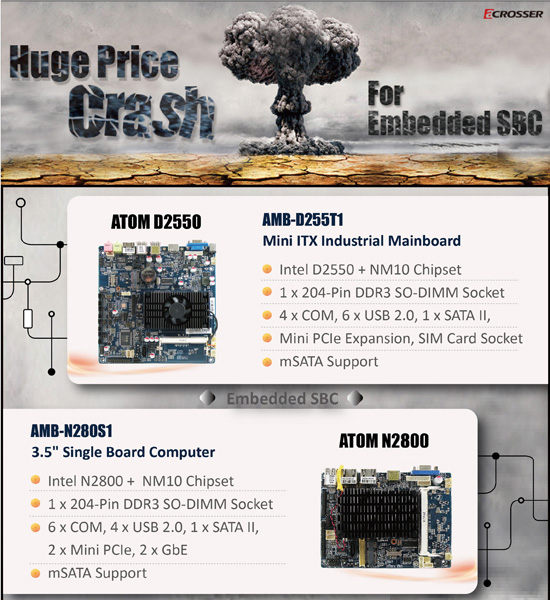
Price Crash for Embedded SBC
The new Atom series solutions that include AMB-D255T1 Mini-ITX industrial mainboard and AMB-N280S1 fanless 3.5-inch single board computer.
AMB-D255T1 is equipped with Intel D2550 Atom processor and Intel N2800
Atom processor is on AMB-N280S1 both have 5~7 years product life cycle
for longevity support.
AMB-D255T1 features powerful graphic performance via VGA and HDMI output, one DDR3 SO-DIMM socket, mSATA socket with USB signals and SIM slot, and a +12V DC jack for easy power input. AMB-D255T1 also provides complete I/O such as 4 x COM ports, 6 x USB2.0 ports, 1 x GbE RJ-45 port, 1 x SATA port with power connector.
AMB-N280S1 has variety I/O ports like 5 x serial ports (one is RS-232/422/485 selectable), 4 x USB2.0, 2 x GbE RJ-45 ports, and one Mini-PCIe expansion. It also offers 1 x SATA interface and power connector for the customers have large storage capacity request. There is one HDMI port and one VGA output on AMB-N280S1 can support both two displays to maximum resolution 1920 x 1200. It also offers the 18-bit LVDS interface for small size LCD panel.
AMB-D255T1 features powerful graphic performance via VGA and HDMI output, one DDR3 SO-DIMM socket, mSATA socket with USB signals and SIM slot, and a +12V DC jack for easy power input. AMB-D255T1 also provides complete I/O such as 4 x COM ports, 6 x USB2.0 ports, 1 x GbE RJ-45 port, 1 x SATA port with power connector.
AMB-N280S1 has variety I/O ports like 5 x serial ports (one is RS-232/422/485 selectable), 4 x USB2.0, 2 x GbE RJ-45 ports, and one Mini-PCIe expansion. It also offers 1 x SATA interface and power connector for the customers have large storage capacity request. There is one HDMI port and one VGA output on AMB-N280S1 can support both two displays to maximum resolution 1920 x 1200. It also offers the 18-bit LVDS interface for small size LCD panel.
2013年3月4日 星期一
Embedded Innovator - Strategies: Dr. Kwok Wu, Head of Embedded Software and Systems Solutions, Freescale Semiconductor
Kwok Wu has many years of experience in advanced embedded systems and software, FPGA software development, and Electronic Design Automation (EDA). He has delivered high-performance scalable software platforms and products for Freescale’s Power Architecture, Starcore DSP, ARM, and ZigBee Systems-on-Chips (SoCs) in the wireless broadband networking, telecommunications, consumer, automotive, industrial, smart energy, and telehealth segments. Kwok holds a PhD, EECS (Computer Engineering) from the University of Texas at Austin.
..............
Refer:
http://embedded-computing.com/articles/2012-solutions-freescale-semiconductor/#utm_source=Telehealth%2Bmenu&utm_medium=text%2Blink&utm_campaign=articles
2013年2月24日 星期日
About the touch-screen sector
With the touch-screen sector now entering a new phase of innovation, the issue of applying multitouch operation to the larger format displays found in industrial and public use settings is becoming a key engineering concern. Designers must examine the sensor technology options available today and consider using new single-layer project capacitive sensing technology to enable sophisticated human-machine interactions in large displays destined for harsh environments.
Multitouch
sensor technology has the potential to revolutionize the way we connect
with all manner of electronics hardware, giving touch-screen-based
Graphical User Interfaces (GUIs) the ability to recognize complex
gestures using several fingers such as rotating, two-digit scrolling,
three-digit dragging, and pinch zoom, as well as allowing multiple users
to collaborate. Analyst firm Markets & Markets predicts that the
global multitouch business will reach $5.5 billion by 2016 (constituting
more than 30 percent of the total touch panel
market by this stage). The multitouch segment is currently exhibiting a
compound annual growth rate of more than 18 percent, with the portable
consumer sector driving the vast majority of this growth.
Moving
forward, the problem for design engineers is knowing how to bring the
multitouch capabilities that are already becoming commonplace in smartphones and tablet PCs to other areas that could also derive benefit from them. Digital signage, Point-Of-Sale (POS),
public information, and industrial control systems could profit greatly
from this sort of functionality. However, certain obstacles are
inhibiting the adoption of multitouch in these nonconsumer sectors.
The
larger format multitouch sensor options currently on the market, though
acceptable for personal use such as all-in-one touch PCs, have serious
shortcomings when applied to more demanding application scenarios. Both
infrared and camera-based systems require an exposed bezel for housing
sensor elements. This means that, in addition to increasing
vulnerability to damage from external forces, the buildup of dust or
dirt in the bezel recesses can hamper operational performance over time.
These systems also suffer from sensor drift and need regular
recalibration to rectify this.
Certain forms of projective capacitance such as self-capacitive types, which by their nature are extremely sensitive in
the Z-axis, have proved to be well suited for rugged touch-screen
implementations and can measure two independent touch points
simultaneously. Another form of projected capacitive sensing, mutual
capacitive, which measures charge/discharge across a crossover or node
between adjacent cells created by an X-Y grid, tends to be less
sensitive in the Z-axis and thus typically only works well with thin
glass. However, mutual capacitive sensing offers the ability to detect
more than two independent touch points when mated with the appropriate
control electronics and software. As a result, this technology has been
chosen in recent years as the principal method of bringing multitouch
functionality to consumer applications.
refer:
2013年2月6日 星期三
Intel Atom D2550 1.86GHz for Digital Signage and POS application
Slim Mini-ITX mainboard with Atom D2550, DDR3, HDMI, GbE, COM for Digital Signage and POS application.
Mini-ITX mainboard, AMB-D255T1, which carries the Intel dual- core 1.86GHz Atom Processor D2550. AMB-D255T1 features powerful graphic performance via VGA and HDMI, DDR3 SO-DIMM support, mSATA socket with USB signals and SIM slot, and a DC jack for easy power in.
AMB-D255T1 has one MiniPCIe type expansion slot with SIM card socket for customer’s expansion. This expansion slot works with SATA and USB signals that can be equipped with mSATA storage module, Wi-Fi module, or 3G/4G telecommunication module.
2013年2月5日 星期二
Intel H61 with CoreTM i7/ i5/ i3 Mini-ITX AMB-IH61T1
The AMB-IH61T1 is the new Mini-ITX industrial mainboard that supports Intel Xeon processor and both of 2nd and 3rd generation Intel Core i7/i5/i3 desktop processor by Intel H61 chipset and LGA 1155 socket.
AMB-IH61T1 has two DDR3 SO-DIMM sockets to support up to 16GB of system memory. Onboard 18/24-bit dual channels LVDS interface support HD resolution LCD panel directly made it suitable for digital signage and panel PC applications.
Coming with Acrosser’s 7 years product longevity service, AMB-IH61T1 is the perfect solution to deliver high computing power for a wide range of applications such as industrial automation, kiosk, digital signage, and ATM machines.
AMB-IH61T1 has two DDR3 SO-DIMM sockets to support up to 16GB of system memory. Onboard 18/24-bit dual channels LVDS interface support HD resolution LCD panel directly made it suitable for digital signage and panel PC applications.
Coming with Acrosser’s 7 years product longevity service, AMB-IH61T1 is the perfect solution to deliver high computing power for a wide range of applications such as industrial automation, kiosk, digital signage, and ATM machines.
2013年1月22日 星期二
Acrosser In-Vehicle PC AR-V6005FL & AR-V6100FL Win Adward
AR-V6005FL
features:
• Intel Atom E640 1.0GHz Processor + EG20T
• DDR2 1GB onboard
• Intelligent Power module support 9~32VDC input
• Fanless design system
• Dual Display:VGA (via Combo Connector), DVI
• RS-232 interface:3 x External ( 1 x RS232/422/485 switch selectable), 1 x Internal
• IO:USB x 1, MIC-in/Speaker, GbE x 1
• Storage:CF card / 2.5” HDD bay
• Optional module:Bluetooth / GPS / WiFi / 3.5G GSM module
• 9-32 VDC power input
• –20℃ to 60℃ operation temperature
AR-V6100FL features:
• Fanless system supports 45W PGA Intel Core i7/i5 and Celeron processors
• Two DDR3 SO-DIMM with 2GB DDR3 pre-installed
• HDMI/DVI/VGA video outputs
• CAN bus 2.0 A/B
• Optional Wi-Fi, Bluetooth, 3.5G, GPS Modules
• RS-232 Interface:2 x External (1 x RS232/422/485 switch selectable), 1 x Internal
• Storage:CF / 2.5” HDD bay
• One-wire (i-Button) interface
• 9-32 VDC power input
• –20℃ to 60℃ operating temperature
AR-V6005 & AR-V6100 also support the optional GPS/GPRS/WiFi module inside one compact system, to fulfill the highly demand from telematic applications.
• Intel Atom E640 1.0GHz Processor + EG20T
• DDR2 1GB onboard
• Intelligent Power module support 9~32VDC input
• Fanless design system
• Dual Display:VGA (via Combo Connector), DVI
• RS-232 interface:3 x External ( 1 x RS232/422/485 switch selectable), 1 x Internal
• IO:USB x 1, MIC-in/Speaker, GbE x 1
• Storage:CF card / 2.5” HDD bay
• Optional module:Bluetooth / GPS / WiFi / 3.5G GSM module
• 9-32 VDC power input
• –20℃ to 60℃ operation temperature
AR-V6100FL features:
• Fanless system supports 45W PGA Intel Core i7/i5 and Celeron processors
• Two DDR3 SO-DIMM with 2GB DDR3 pre-installed
• HDMI/DVI/VGA video outputs
• CAN bus 2.0 A/B
• Optional Wi-Fi, Bluetooth, 3.5G, GPS Modules
• RS-232 Interface:2 x External (1 x RS232/422/485 switch selectable), 1 x Internal
• Storage:CF / 2.5” HDD bay
• One-wire (i-Button) interface
• 9-32 VDC power input
• –20℃ to 60℃ operating temperature
AR-V6005 & AR-V6100 also support the optional GPS/GPRS/WiFi module inside one compact system, to fulfill the highly demand from telematic applications.
2013年1月15日 星期二
Intel 3rd generation mobile processors supported by the AMB-QM77T1 features an integrated GPU
The AMB-QM77T1 is the newest Mini-ITX industrial mainboard from Acrosser
Technology that supports both of the 3rd and 2nd generation Intel Core i7/i5/i3
mobile processor by Intel QM77 chipset and FCPGA 988 socket.
Coming with Acrosser’s 7 years
product longevity service, AMB-QM77T1 is the perfect solution to deliver high
computing power for a wide range of applications such as medical, industrial
automation,
kiosk, digital
signage, and
ATM
machines.
The key features of the AMB-QM77T1 include:
‧ Intel QM77 chipset
‧ FCPGA socket supports 3rd Generation Intel® Core(TM) i7/i5/i3 processors and Celeron
‧ 2* DDR3-1600/1333/1066 SO-DIMM up to 16GB
‧ Supports VGA/DVI-D/HDMI/LVDS displays
‧ Support 3 independent display
‧ Dual Intel PCI-E Gigabit LAN
‧ 8* USB 2.0, 4* USB 3.0, 3* COM, 3* SATA II, 2* SATA III
‧ 1* PCI-E x16, 1* Mini PCI-E, 1* CFast socket
‧ iAMT 8.0, TPM 1.2, Watchdog timer, Digital I/O Support VGA and DVI output
The key features of the AMB-QM77T1 include:
‧ Intel QM77 chipset
‧ FCPGA socket supports 3rd Generation Intel® Core(TM) i7/i5/i3 processors and Celeron
‧ 2* DDR3-1600/1333/1066 SO-DIMM up to 16GB
‧ Supports VGA/DVI-D/HDMI/LVDS displays
‧ Support 3 independent display
‧ Dual Intel PCI-E Gigabit LAN
‧ 8* USB 2.0, 4* USB 3.0, 3* COM, 3* SATA II, 2* SATA III
‧ 1* PCI-E x16, 1* Mini PCI-E, 1* CFast socket
‧ iAMT 8.0, TPM 1.2, Watchdog timer, Digital I/O Support VGA and DVI output
2013年1月7日 星期一
The Intel® Atom™ processor is designed to keep you moving
The Intel® Atom™ processor is designed to keep you moving, whether it’s in a smartphone, embedded application, tablet or microserver.
With an Intel® Atom™ processor-based tablet, you’re going to have one of the lightest tablets around. And you won’t sacrifice performance at all.With lead-free and halogen-free manufacturing, the Intel® Atom™ processor is also an environmentally responsible choice.
from
1.http://www.intel.com/content/www/us/en/processors/atom/atom-processor-details.html?wapkw=atom
2.http://ark.intel.com/products/49490
2013年1月1日 星期二
Fanless In-Vehicle computer with Intel 3rd Generation Core i platform
Its newest in-vehicle computer AIV-HM76V0FL features Intel HM76 mobile chipset and FCPGA 988 socket for 3rd generation Core i mobile computer platform. AIV-HM76V0FL adopts Acrosser’s expertise of design for in-vehicle applications. These designs include smart power management, high efficient thermal module, and diversity of integrated communication technology such as 4 USB 3.0, CAN bus, Wi-Fi, 3.5G wireless WAN, Bluetooth and GPS.
AIV-HM76V0FL is protected with the most complete power input protection to adapt the harsh electrical environment in any kind of vehicle. Such protections are automotive transient voltage suppression, over/under voltage protection, over current protection, reverse voltage protection and automotive fuse. These designs enable AIV-HM76V0FL to pass the strict ISO-7637-2 test what is specifically defined for equipments installed in various vehicles.
The smart power management subsystem enables user to define the power on and off sequences through software interface or BIOS setting to meet any requirement of in-vehicle applications.
The AIV-HM76V0FL’s fanless thermal design provides the high reliability in vehicle applications. It utilizes advanced heat pipe, heat sink, and thermal pad to solve the problem of heat generated by CPU, Chipset, DRAM and power devices. This is a big challenge for designing a fanless computer what supports up to 45 Watts quad core of core i7-3720QM processors. All components used in AIV-HM76V0FL are industrial proven and only solid state capacitors are utilized for high MTBF.
訂閱:
文章 (Atom)